
THE PRESIDENCY
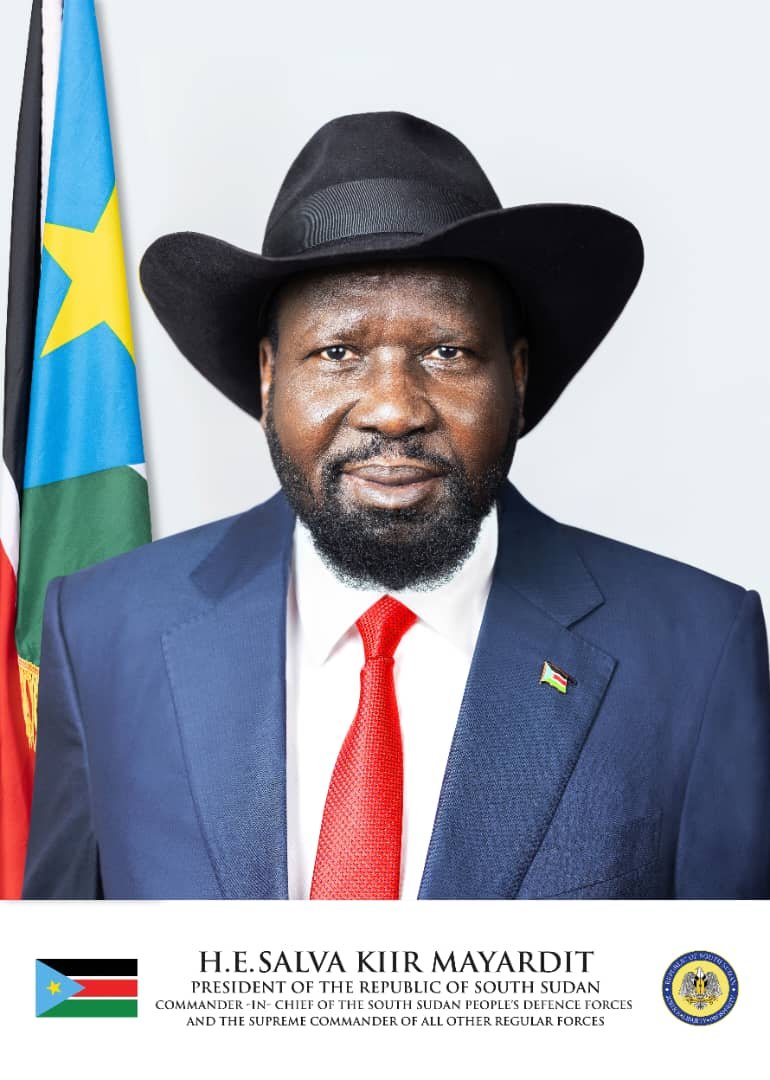
THE PRESIDENT
His Excellency General Salva Kiir Mayardit was sworn in on 9 July 2011 as the first President of the Republic of South Sudan following the country’s independence. He serves as Head of State, Head of Government, and Commander-in-Chief of the South Sudan People’s Defence Forces (SSPDF), as well as Supreme Commander of all Regular Forces.
President Kiir was born in Akon Village, Gogrial West County, Warrap State. He was raised in a rural community with strong cultural and Christian values. He attended Akon Primary School and Kuajok Intermediate School, then completed his secondary education in Rumbek.
Driven by a deep sense of national service, he later joined the Sudan Military College, where he trained in infantry and military intelligence. Upon graduation, he was commissioned as a Second Lieutenant and subsequently advanced through the ranks.
At a young age, President Kiir joined the Anyanya liberation movement, dedicating himself to the struggle for justice, equality, and self-determination for the people of Southern Sudan.
He later became one of the founding members of the Sudan People’s Liberation Movement/Army (SPLM/A), serving as Deputy Chairman and Deputy Commander-in-Chief during the liberation struggle. Throughout the struggle, he played a key role in military organisation, national mobilisation, and advancing the peace process.
Following the tragic death of Dr John Garang de Mabior in 2005, President Kiir assumed leadership of the SPLM/A and, under the Comprehensive Peace Agreement, became the First Vice President of the Republic of Sudan and the President of the Government of Southern Sudan.
On 9 July 2011, upon South Sudan’s independence, he was sworn in as the first President of the Republic of South Sudan, marking the birth of the world’s newest nation and the formal transfer of sovereignty to its people.
Under the Transitional Constitution of the Republic of South Sudan, 2011 (as amended), the President exercises executive authority as Head of State and Government. His constitutional responsibilities include safeguarding national sovereignty and territorial integrity, promoting peace and national unity, directing foreign relations, appointing constitutional office-holders, and ensuring the implementation of the Constitution and the laws of the Republic.
As President, His Excellency continues to guide the nation’s efforts towards peace, stability, reconciliation, and national development.